

How Can a Ruler Screen Printing Machine Improve Precision and Output in Modern Stationery Production?
2026-04-10
When I look at the real challenges in stationery manufacturing, I do not see “printing” as a simple decorative step. I see it as a precision process that directly affects readability, measurement accuracy, product consistency, and delivery speed. That is exactly why I pay close attention to solutions like the Ruler Screen Printing Machine. As production demands become stricter, many buyers are no longer satisfied with equipment that only prints. They want a machine that can hold position accurately, run steadily, adapt to different ruler formats, and reduce avoidable waste. In that context, Dongguan Hoystar Machinery Co., Ltd. gradually comes into view as a manufacturer focused on practical printing equipment for industrial applications, especially when buyers need a more reliable answer to ruler and scale marking production.
For me, the value of a Ruler Screen Printing Machine is not limited to ink transfer. It lies in how the machine supports repeatability, controls alignment, protects production rhythm, and helps manufacturers maintain product quality from the first batch to the next. If a ruler scale is not clean, centered, and durable, the end product immediately loses trust. That is why this kind of equipment matters so much for factories producing rulers, triangular rulers, protractors, and similar measuring tools.
Why Does Precision Matter So Much in Ruler Printing?
I often find that buyers underestimate how unforgiving ruler printing can be. On many consumer products, a minor print deviation may be tolerated. On a ruler, however, every line and every numeral must appear clear, stable, and positioned correctly. Even a small registration issue can affect usability, appearance, or brand reputation.
- Measurement markings need clean edge definition
- Logos and model information must remain legible
- Scale spacing must appear visually consistent
- Multiple product sizes require flexible setup
- Large-volume orders demand stable repeat performance
That is why I see a specialized Ruler Screen Printing Machine as a more suitable choice than a general-purpose solution when the product category is clearly defined. A dedicated design helps reduce movement during printing, improve alignment, and support better consistency across long production runs.
What Problems Do Buyers Usually Face with Traditional Printing Methods?
Before choosing the right machine, I always like to identify the pain points first. In ruler and scale printing, the most common problems are not abstract at all. They show up on the shop floor every day.
- Manual positioning takes too much time
- Printed scales shift because the workpiece is not held firmly
- Different ruler lengths require frequent fixture changes
- Output is too low for growing order volumes
- Operators struggle to maintain uniform print quality
- Rework increases because of blur, misalignment, or unstable ink transfer
These issues cost more than labor alone. They affect delivery schedules, material utilization, and customer confidence. That is why I believe investing in a better Ruler Screen Printing Machine is often a production decision rather than only a purchasing decision.
Which Features Make a Specialized Ruler Printing Solution More Practical?
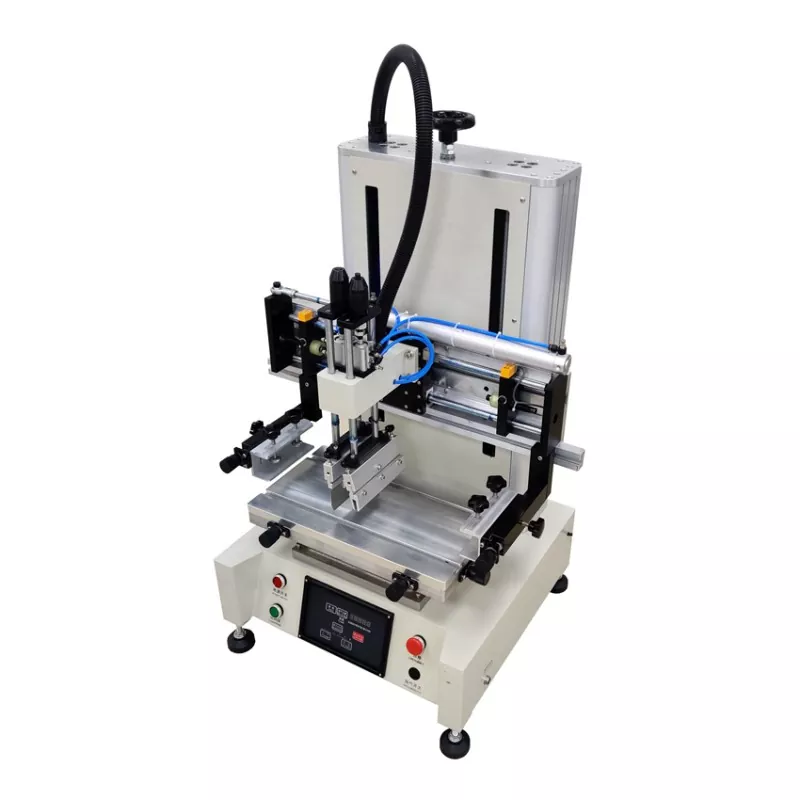
When I evaluate this category of equipment, I usually focus on function before appearance. A practical machine should help factories solve real production problems rather than simply add automation for show. Based on the product direction shown by Dongguan Hoystar Machinery Co., Ltd., a well-positioned ruler printing machine typically emphasizes accurate holding, stable motion, support for different ruler formats, and more efficient operation for repetitive jobs.
| Feature | Why I Think It Matters | Production Benefit |
| Vacuum worktable | Helps keep rulers in place during printing | Better alignment and more uniform print results |
| Support for different fixture changes | Makes it easier to handle multiple ruler sizes or shapes | Greater flexibility for mixed orders |
| Optional control upgrades | Improves setup efficiency and parameter control | More repeatable operation and easier adjustment |
| Automatic feeding and unloading on selected models | Reduces dependence on manual repetitive handling | Higher throughput and lower labor pressure |
| High-speed rotary worktable on automatic versions | Supports faster cycle times in large production runs | Improved overall productivity |
For me, these are not decorative specifications. They are the features that often decide whether a machine will actually perform well in everyday production.
How Does a Ruler Screen Printing Machine Help Reduce Waste and Rework?
In many factories, profit is quietly lost in small repeated errors. Misprints, double handling, inconsistent alignment, and rejected parts may not look dramatic on one shift, but they add up quickly over weeks and months. A properly selected Ruler Screen Printing Machine can help reduce these losses by stabilizing the printing process itself.
I usually look at waste reduction from four angles:
- Less movement of the workpiece during printing
- More consistent placement of scales and text
- Fewer operator-dependent quality variations
- Higher repeatability on longer production runs
When rulers are held more securely and processed more consistently, factories can spend less time correcting output and more time shipping finished products. That shift alone can improve both operational confidence and customer satisfaction.
Is Semi Automatic or Fully Automatic Better for Ruler Production?
I do not think there is one universal answer. The better choice depends on order volume, product variety, labor cost, and how standardized the production line already is. Some buyers need flexibility first. Others need throughput first.
| Machine Type | Best For | What I See as the Main Advantage | What Buyers Should Consider |
| Semi-automatic | Small to medium batches, mixed products, flexible workshops | Easier integration and simpler operation | Output may be lower than fully automatic systems |
| Automatic | High-volume ruler or stationery production | Continuous printing with stronger productivity potential | Requires clearer production planning and line coordination |
From what I see, Dongguan Hoystar Machinery Co., Ltd. presents both semi-automatic and automatic directions for this category, which is useful because not every buyer is at the same production stage. Some factories want a compact entry point, while others are already focused on faster, continuous output.:contentReference[oaicite:1]{index=1}
What Should I Check Before Buying a Ruler Screen Printing Machine?
When I help assess equipment, I prefer asking practical questions instead of chasing broad promises. A machine should match the buyer’s real product mix and workflow. Otherwise, even a technically good machine can become an awkward fit.
- What ruler materials will be printed, such as plastic, metal, or wood?
- What are the common ruler sizes and printing areas?
- Will the factory mainly print scale marks, logos, safety text, or all of them?
- How important is fast changeover between different product formats?
- Is the buyer trying to reduce labor, increase capacity, or improve consistency first?
- Will the machine need to fit into an existing production line?
I also like to compare the expected daily output with the current bottleneck. If the main issue is repeated manual handling, then automation becomes more attractive. If the main issue is unstable registration, then fixture design and workpiece holding matter even more.
Why Does Machine Stability Matter More Than a Long Feature List?
In industrial buying, I have noticed that a long list of features can sound impressive at first but does not always solve the real issue. In screen printing, stability is often the hidden factor behind quality. If a machine runs smoothly, holds the product correctly, and maintains repeatable motion, the printing result becomes easier to control.
That matters especially for rulers, where the print is not only decorative but functional. A scale line that looks slightly off can immediately make the product feel low grade. For that reason, I would rather choose a well-built Ruler Screen Printing Machine with a clear application focus than a generic machine that promises everything but delivers unstable output.
How Can the Right Equipment Support Different Stationery Products?
One of the things I appreciate in this product category is its practical relevance beyond standard straight rulers. Many factories produce related items as part of a wider stationery range. That means the machine should not feel locked into only one rigid format.
In real production, buyers may need to print on:
- Straight plastic rulers
- Metal rulers
- Wood rulers
- Triangle rulers
- Protractors
- Promotional measuring tools with custom logos
When equipment supports fixture replacement and reasonable format adjustment, it becomes easier for manufacturers to respond to varying order requirements without replacing the entire system. That kind of flexibility is valuable for exporters, OEM suppliers, and contract manufacturers handling multiple customer specifications.
Which Buyers Can Benefit Most from This Type of Machine?
I see the strongest fit for factories that cannot afford loose print consistency anymore. If measurement markings are part of the product’s core function, then equipment quality matters a lot.
| Buyer Type | Why This Machine Is Relevant |
| Stationery manufacturers | Need reliable, repeatable printing on ruler products and related items |
| Educational supply producers | Require clear scale markings and neat product appearance |
| Promotional product suppliers | Need flexible logo and scale printing across different formats |
| OEM and contract manufacturers | Must balance output, consistency, and fast changeovers for customer orders |
| Growing factories upgrading from manual work | Need a more efficient path toward stable production |
For these buyers, a specialized Ruler Screen Printing Machine can become part of a smarter production strategy rather than just another item on the equipment list.
What Makes Long Term Supplier Cooperation Worth Considering?
When I choose industrial equipment, I am never only buying the machine. I am also evaluating whether the supplier understands the application, supports customization, and can communicate clearly through the project. That matters even more when the machine may need to match a buyer’s ruler dimensions, production rhythm, or automation expectations.
What I usually look for in a supplier includes:
- Clear understanding of the actual printing application
- Ability to discuss machine configuration realistically
- Support for customization when product formats differ
- Stable production and quality control mindset
- Willingness to communicate before and after the order
That is why many buyers prefer to work with manufacturers that focus on this field rather than resellers with limited technical depth. A supplier that understands the details of ruler printing can often help shorten the path from inquiry to usable production.
How Do I Decide Whether It Is Time to Upgrade My Current Printing Setup?
I think the answer becomes obvious when the same production issues keep returning. If operators are spending too much time on alignment, if rejection rates rise during busy periods, or if output cannot keep up with demand, then the current setup may already be costing more than expected.
Here are the warning signs I would not ignore:
- Your print position varies too much from batch to batch
- Your current workflow depends too heavily on operator experience
- Your delivery times suffer when orders increase
- Your factory handles multiple ruler formats and needs better flexibility
- Your customers are asking for cleaner branding and more consistent scales
Once these issues become regular, upgrading to a better Ruler Screen Printing Machine is no longer just a technical improvement. It becomes a business decision tied to quality, reputation, and competitiveness.
Why Should Buyers Talk with Dongguan Hoystar Machinery Co., Ltd. About Their Production Needs?
From my perspective, the best equipment discussion starts with the buyer’s actual products, target output, and production constraints. Dongguan Hoystar Machinery Co., Ltd. focuses on ruler screen printing solutions within a broader printing machinery offering, and that makes the conversation more useful for buyers who want practical matching rather than vague sales language. Whether the requirement is a compact semi-automatic option or a more efficient automatic solution for larger-volume ruler production, it makes sense to discuss the application in detail and compare configurations based on real manufacturing needs.:contentReference[oaicite:2]{index=2}
If you are looking for a dependable Ruler Screen Printing Machine that can help improve print precision, reduce production inconsistency, and support your factory’s next stage of growth, this is the right time to take the next step. Contact us to discuss your ruler sizes, materials, printing requirements, and output goals. If you want a more suitable configuration for your own production line, contact us now and send your inquiry to explore the right solution for your business.