

When I look at modern printing workshops, one problem appears again and again. Teams can print well, but they still lose time while waiting for ink, coating, or varnish to cure properly. That delay affects delivery speed, surface quality, rework cost, and even customer confidence. This is why I have paid close attention to Dongguan Hoystar Machinery Co., Ltd., a manufacturer that has gradually built practical curing solutions for screen printing, pad printing, packaging, plastic products, and many custom production needs. For buyers who want a more stable finishing process, a UV Curing Machine is not just another machine on the floor. It can become the part of the line that protects print quality and keeps production moving.
I usually see buyers start their search because something in their current workflow is holding them back. The printed surface may stay tacky for too long. The coating may look uneven. Operators may need too much space for air drying racks. A batch may pass inspection in the morning and fail later because adhesion was not fully stable. These are not small issues. They directly affect profit, lead time, and repeat orders. A well-matched UV Curing Machine helps solve these problems by using ultraviolet light to cure UV ink, varnish, or coating in a controlled and repeatable way.
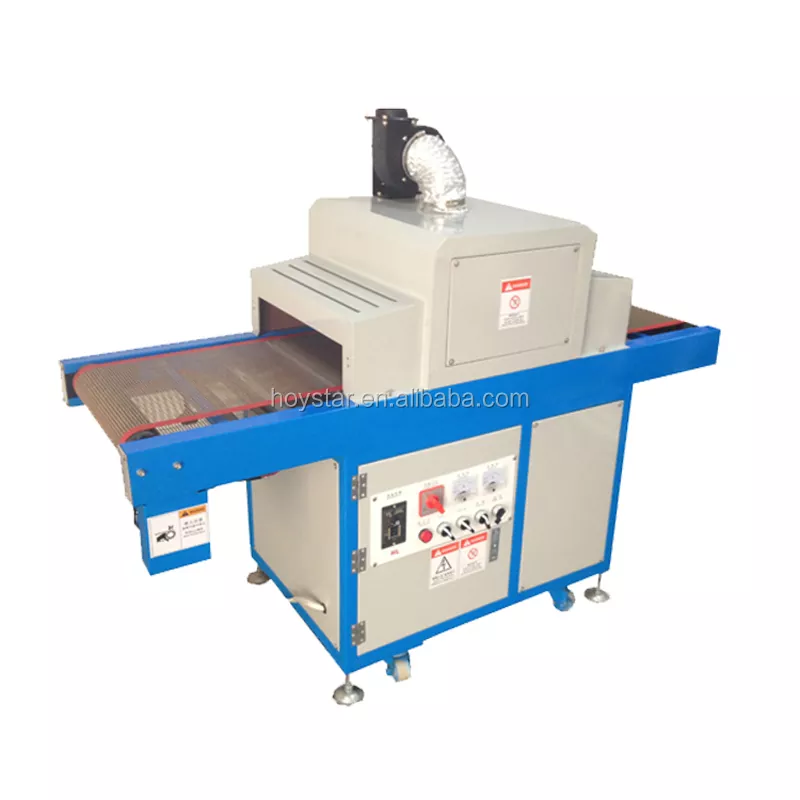
What Problems Can a UV Curing Machine Solve in Daily Production?
I always prefer to judge equipment by the problems it removes from the workshop. In printing and coating work, drying is often treated as a simple back-end step, but it can quietly become the slowest and most unpredictable part of the whole process. A UV Curing Machine changes that by turning curing into a planned, measurable, and faster operation.
- It reduces waiting time after printing, especially when UV ink or coating is used.
- It helps improve surface hardness, gloss consistency, and adhesion.
- It lowers the risk of dust sticking to wet ink during long drying periods.
- It helps reduce smudging, scratches, and handling damage before packaging.
- It saves floor space by replacing long natural drying areas with a compact curing process.
- It supports more stable output for repeat orders and batch production.
From my point of view, the biggest value is not only speed. The real value is control. Once the curing time, conveyor speed, lamp position, and product placement are adjusted correctly, operators can repeat the same result again and again. That matters a lot when a buyer is supplying printed parts, promotional items, plastic components, labels, packaging materials, or decorated industrial products.
Which Production Lines Benefit Most from a UV Curing Machine?
I would not recommend the same curing setup for every factory. A small workshop printing custom cards has different needs from a plant producing larger plastic parts or cylindrical bottles. However, the demand behind the purchase is often similar. Buyers want cleaner curing, fewer defects, and a faster move from printing to packing.
| Application Area | Common Buyer Pain Point | How UV Curing Helps |
|---|---|---|
| Screen printing | Printed layers take too long to dry before the next process | Fast curing helps keep the production line moving with fewer pauses |
| Pad printing | Small parts are easy to smudge during handling | Controlled curing improves surface stability before inspection or packing |
| Plastic products | Ink adhesion may be inconsistent on different surfaces | Proper UV exposure supports better coating and ink performance |
| Bottles and containers | Curved surfaces may cure unevenly | Special fixtures or rotating designs help expose the printed area more evenly |
| Labels and cards | High-volume orders need quick finishing and stable gloss | Conveyor curing improves batch consistency and shortens delivery cycles |
This is where Dongguan Hoystar Machinery Co., Ltd. becomes relevant for buyers who need more than a standard machine. The company’s product direction covers compact models, conveyor-type curing equipment, and customized curing options for different shapes and production layouts. That range gives buyers more room to match equipment with real work conditions instead of forcing the workshop to adapt to one fixed machine.
Is a Desktop UV Curing Machine Enough for Small Batch Work?
In many cases, yes. I often see small studios, sample rooms, and custom printing shops hesitate because they think UV curing equipment must be large, expensive, and difficult to operate. A desktop UV Curing Machine can be a better starting point when the product size is small and the order volume is flexible.
This type of machine is useful when the buyer needs to cure printed promotional items, labels, PVC cards, small plastic parts, test samples, or short-run custom products. The main advantages are simple operation, smaller footprint, easier placement, and lower entry cost. For a buyer who is moving from manual drying to UV curing, a desktop model can make the transition less risky.
- I would choose a desktop unit when the product size is limited and the workshop space is tight.
- I would use it for sampling when operators need to test ink, coating, or exposure conditions before mass production.
- I would consider it for custom orders where flexibility matters more than continuous high-speed output.
- I would avoid it if the buyer needs nonstop production for wide materials or large printed parts.
Which UV Curing Machine Works Better for Continuous Output?
For production lines that need higher volume, I usually look at conveyor-type curing equipment. A conveyor UV Curing Machine is designed to move products through the curing area at a controlled speed. This makes it suitable for factories that want to connect curing with screen printing, pad printing, or other finishing steps.
Conveyor curing is especially useful when products must pass through the same exposure condition repeatedly. Operators can adjust the conveyor speed according to ink type, coating thickness, lamp power, and surface material. Once the settings are stable, the line becomes easier to manage.
| Selection Point | What I Check | Why It Matters |
|---|---|---|
| Curing width | Maximum product size and printed area | The curing chamber must cover the real working area, not only the sample size |
| Conveyor speed | Speed range and adjustment accuracy | Different inks and coatings may need different exposure times |
| Lamp layout | UV coverage and exposure uniformity | Uneven light can create weak curing, patchy gloss, or adhesion problems |
| Heat control | Ventilation and temperature protection | Some substrates may deform or react badly under excessive heat |
| Safety design | Protective cover and operator protection | UV exposure must be controlled for a safer working environment |
Do Curved Bottles and Irregular Products Need a Different UV Curing Machine?
Yes, and this is a detail many buyers miss at the beginning. Flat sheets and cards are easier to cure because the UV light can reach the surface directly. Curved bottles, jars, tubes, containers, and uneven plastic parts need more careful handling. If the exposure is not balanced, one side may cure well while another side remains weak, dull, or sticky.
For these products, I would look for customized clamping, rotation, or fixture support. A specialized UV Curing Machine can hold the product in a better position and help the UV light reach the printed area more evenly. This is especially important for cosmetic packaging, drinkware, household containers, and promotional bottles.
- For round bottles, I check whether the product can rotate smoothly during curing.
- For mixed product sizes, I check whether fixtures are adjustable.
- For glossy coating, I check whether the final surface stays even from top to bottom.
- For industrial parts, I check whether the machine can support repeat placement without slowing down operators.
What Should I Check Before Buying a UV Curing Machine?
I never suggest choosing curing equipment by price alone. A cheaper unit may look attractive, but if it cannot match the ink, product size, production speed, or safety needs, the buyer may spend more later on rework and downtime. A practical buying process should start with the product and workflow.
| Question I Ask | Reason Behind the Question |
|---|---|
| What material will be printed or coated? | Plastic, paper, metal, glass, and coated surfaces may respond differently to UV exposure and heat |
| What UV ink or coating will be used? | Curing requirements depend on ink chemistry, layer thickness, and finish expectations |
| What is the largest product size? | The machine must provide enough curing area for actual production, not only trial samples |
| How many pieces must be processed per hour? | Output target affects conveyor type, lamp power, and machine size |
| Will the machine connect with other printing equipment? | Line integration affects height, speed, loading method, and workshop layout |
| Does the product have a flat or curved surface? | Curved products may need rotation, fixtures, or customized curing structures |
When these answers are clear, the supplier can recommend a more suitable configuration. That is why I prefer working with a manufacturer that understands printing equipment as a complete workflow, not just as isolated machines. Dongguan Hoystar Machinery Co., Ltd. produces printing and curing equipment, so the selection discussion can include how curing connects with real production steps.
Is UV Curing Better Than Traditional Drying for Printed Products?
I would not say one method fits every job, but UV curing has strong advantages when the ink or coating is designed for UV reaction. Traditional drying often depends on evaporation, air movement, time, and environmental conditions. That can create variation between summer and winter, dry and humid weather, or small and large batches.
A UV Curing Machine gives the buyer a more controlled process. The product passes through a defined curing zone, receives planned UV exposure, and can usually be handled much sooner. For factories facing tight delivery schedules, this difference can be significant.
- Traditional drying may require more floor space for racks or waiting zones.
- UV curing can reduce the time between printing, inspection, and packaging.
- Traditional drying can expose wet surfaces to dust and accidental contact for longer periods.
- UV curing can support sharper production planning for repeat orders.
- Traditional drying may be acceptable for some materials, but it can become a bottleneck in faster production lines.
How Does the Right UV Curing Machine Improve Product Quality?
Quality problems in curing are often subtle at first. A product may look fine when it leaves the printing area, but later the ink scratches, the gloss changes, or the coating fails during handling. These issues can damage a buyer’s reputation, especially when products are shipped overseas or used as branded packaging.
The right UV Curing Machine helps improve quality because it makes curing more predictable. With suitable exposure and stable movement, the printed surface can gain better hardness, cleaner finish, and stronger adhesion. This does not replace good ink selection or proper surface treatment, but it supports the final result in a very direct way.
| Quality Goal | How Proper UV Curing Supports It |
|---|---|
| Better adhesion | Controlled exposure helps UV ink or coating form a stronger cured layer |
| Cleaner surface | Fast curing reduces the time when dust and debris can stick to wet ink |
| More stable gloss | Even UV distribution helps reduce patchy or dull areas |
| Lower handling damage | Products can move to inspection or packaging sooner after curing |
| More repeatable batches | Adjustable settings help operators keep consistent curing conditions |
What Makes Dongguan Hoystar Machinery Co., Ltd. Worth Considering?
I pay attention to suppliers that understand the daily pressure of production, not just the machine description on a page. Dongguan Hoystar Machinery Co., Ltd. offers curing equipment for different production needs, including compact setups, conveyor curing, and solutions for non-flat products. This matters because many buyers do not need a generic machine. They need equipment that fits their product size, print method, output target, and workshop layout.
I also value the fact that the company works around printing-related equipment, including screen printing and pad printing lines. When a curing machine is selected as part of a wider printing process, the buyer can discuss feeding, curing width, production speed, surface requirements, and after-sales support together. That can reduce misunderstanding before purchase.
- The product range can support small workshops and larger production lines.
- The equipment direction covers flat products and shaped products.
- The machines are designed for practical curing needs in printing and coating work.
- The supplier can discuss machine selection based on product samples and production goals.
- The buyer can ask for configuration suggestions before confirming the final model.
Which Details Help a Buyer Avoid the Wrong UV Curing Machine?
I have seen buyers focus only on lamp power or machine size, but those are not the only details that matter. The wrong machine can still have strong lamps and fail to cure the product properly if the exposure pattern, conveyor speed, heat control, or fixture design does not match the product.
Before I would place an order for a UV Curing Machine, I would prepare product photos, material details, ink information, expected output, and available workshop space. If possible, I would also send samples or curing requirements to the supplier. This gives the manufacturer a much better chance to recommend the right equipment.
| Buying Mistake | Possible Result | Better Approach |
|---|---|---|
| Choosing only by lowest price | The machine may not match output or product size | Compare performance, safety, support, and fit for the actual workflow |
| Ignoring product shape | Curved areas may cure unevenly | Ask about fixtures, rotation, or customized curing structures |
| Overlooking heat sensitivity | Some materials may deform or lose finish quality | Discuss substrate type and temperature control before purchase |
| Skipping ink information | Curing speed and surface result may not meet expectations | Share UV ink or coating details with the supplier |
| Buying without line planning | The machine may not connect smoothly with existing equipment | Confirm height, loading direction, conveyor speed, and floor space |
How Should I Decide If It Is Time to Upgrade to UV Curing?
I would consider upgrading when drying time starts to limit delivery, when printed surfaces fail too often, or when operators spend too much time moving semi-dry products around the workshop. I would also consider it when a company wants to accept more UV printing work but cannot keep quality stable with its current drying method.
The decision becomes even clearer when rework cost is already visible. If a factory keeps losing pieces because of smudging, dust, weak adhesion, or slow curing, the cost is not only the rejected product. The real cost includes labor, delayed shipment, customer complaints, and lost production capacity. In that situation, a properly selected UV Curing Machine can be a practical investment rather than a simple equipment upgrade.
- I would upgrade when curing becomes the slowest step in the line.
- I would upgrade when operators need too much space for natural drying.
- I would upgrade when the product surface is often damaged before packaging.
- I would upgrade when order volume grows and manual drying becomes unreliable.
- I would upgrade when customers require cleaner gloss, stronger adhesion, or faster delivery.
What Should I Ask Before Requesting a Quote?
A good inquiry saves time for both sides. Instead of asking only for a price list, I would send clear production details so the supplier can recommend a suitable machine. This also makes the quotation more useful because it reflects real application needs.
| Information to Provide | Example Detail |
|---|---|
| Product type | Cards, labels, plastic parts, bottles, containers, panels, or custom items |
| Product size | Length, width, height, diameter, and printed area |
| Material | Plastic, paper, glass, metal, coated board, film, or other substrate |
| Ink or coating | UV ink, UV varnish, UV adhesive, or other curing material |
| Production target | Pieces per hour, batch size, or daily output |
| Workshop layout | Available space, connection with printer, and loading direction |
Once these details are ready, the discussion becomes much more accurate. Dongguan Hoystar Machinery Co., Ltd. can then help buyers compare compact, conveyor, or customized curing options based on real use instead of guesswork.
Why Do I See UV Curing as a Practical Upgrade Instead of a Luxury?
I see UV curing as practical because it solves problems that buyers already pay for every day. Slow drying, unstable adhesion, wasted floor space, surface scratches, and delayed packing all create hidden costs. A well-selected UV Curing Machine helps reduce those costs by making curing faster and more controlled.
The best machine is not always the largest one. It is the one that fits the product, ink, production rhythm, and quality target. For a small workshop, that may mean a compact model that improves sampling and short-run jobs. For a factory, it may mean a conveyor-type machine that supports continuous output. For bottles or irregular products, it may mean a customized curing solution that handles curved surfaces more evenly.
If you are comparing UV curing equipment for printing, coating, packaging, or custom product decoration, I would suggest starting with your real production pain points. Share your product size, material, ink type, output target, and quality requirements with Dongguan Hoystar Machinery Co., Ltd. The team can help you evaluate a suitable UV Curing Machine for your workflow. To request a quotation, discuss customization, or send product details for selection advice, please contact us today and leave your inquiry so the right curing solution can be recommended for your production line.