

Why Is My D2861A Electronically Controlled Rotary Dobby Showing an Emergency Stop Error Code
2026-06-24
If you operate a high-speed weaving line, few alerts stop production faster than an emergency stop error on your D2861A Electronically Controlled Rotary Dobby. This fault triggers a complete machine halt, often accompanied by a red indicator on the control panel. At CHANGFANG, we have supported hundreds of mills in diagnosing and resolving this exact issue. Understanding the root causes—from sensor misalignment to power supply glitches—is the first step to minimizing downtime. This guide breaks down the diagnostic process, offers step-by-step recovery actions, and answers the most frequently asked questions about the D2861A Electronically Controlled Rotary Dobby emergency stop system.
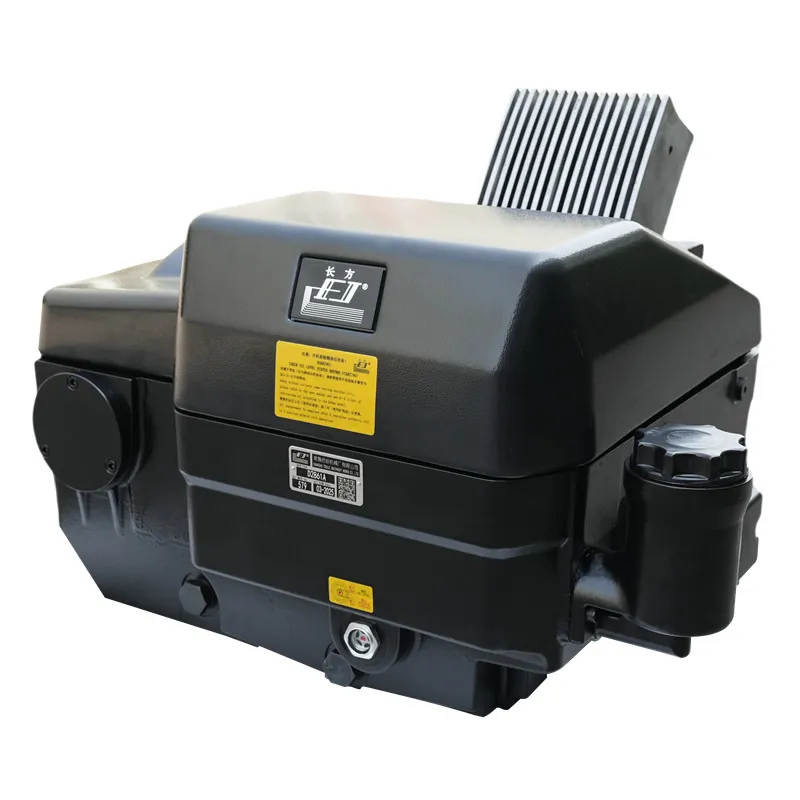
Immediate Diagnostic Checklist
Before calling for service, work through this practical checklist. The emergency stop circuit on the D2861A Electronically Controlled Rotary Dobby is designed to trip under six primary conditions. Use the table below to match your symptom with the most likely cause.
| Error Symptom | Most Likely Cause | Recommended First Action |
|---|---|---|
| Red light steady, no loom movement | Emergency stop button physically pressed | Release all E-stop buttons and reset |
| Red light flashing, display shows "Encoder" | Absolute encoder signal lost | Check encoder cable connection at the rear junction box |
| Alarm sounds intermittently | Solenoid driver overcurrent | Measure resistance across each solenoid group (target: 8–12Ω) |
| Error appears only at high speed (≥650 RPM) | Inadequate cooling air pressure | Clean the cooling fan filter and verify air pressure ≥ 0.6 MPa |
| Reset fails immediately after restart | Main contactor welded | Visually inspect the main power contactor for pitting |
| Display shows "Safety Relay" fault | Door interlock switch misaligned | Adjust the front guard door sensor gap to 2.5 mm ± 0.3 mm |
Step-by-Step Recovery Procedure
Once you have identified the probable cause from the table, follow this structured recovery sequence. CHANGFANG recommends always starting with the simplest physical check before delving into parameters.
-
Physical inspection – Walk around the loom and confirm all emergency stop buttons are fully released. On the D2861A Electronically Controlled Rotary Dobby, there are typically three E-stop points: the main console, the rear frame, and the take-up side.
-
Power cycle sequence – Turn off the main isolator, wait 30 seconds for internal capacitors to discharge, then restart. This clears transient logic glitches.
-
Diagnostic menu access – Navigate to the fault history log (Parameter Group P50). Record the last three fault codes before clearing.
-
Encoder verification – With the machine at standstill, manually rotate the main shaft 360° and watch the encoder position value on the display. It should change smoothly without jumps.
-
Solenoid group isolation – Disconnect each solenoid bank one at a time. If the error disappears, you have isolated a shorted solenoid driver.
Why Does This Error Occur More Frequently in Humid Environments?
Moisture ingress into the terminal strips is a recurring issue. The D2861A Electronically Controlled Rotary Dobby uses low-voltage (24V DC) signals for its safety circuit. High ambient humidity (above 80%) can reduce insulation resistance, causing phantom ground faults that trigger the emergency stop. CHANGFANG offers sealed connector kits specifically designed to mitigate this problem in tropical climates.
3 Critical FAQs About the D2861A Electronically Controlled Rotary Dobby Emergency Stop
Q1: Can I bypass the emergency stop circuit temporarily to finish a production run?
A1: No. Bypassing the safety circuit on the D2861A Electronically Controlled Rotary Dobby is strictly prohibited under international loom safety standards (ISO 11111). It not only places operators at serious risk of injury but also permanently damages the main control board due to unregulated current feedback. If you need to finish a run, CHANGFANG recommends using the "Service Override" mode (Parameter P78 = 1), which allows low-speed crawling (≤ 30 RPM) for troubleshooting while keeping all safety relays active. This mode disengages automatically after 5 minutes.
Q2: How do I differentiate between a true hardware fault and a false trigger caused by electrical noise?
A2: This is a common diagnostic challenge. Perform a "cold isolation test": with the D2861A Electronically Controlled Rotary Dobby powered off, disconnect all external input signals (weft sensor, warp stop, and tension roller). Power back on. If the error disappears, the issue is external noise—typically from variable frequency drives. Install ferrite cores on all signal cables. If the error remains, it is internal hardware. Check the 5V reference voltage on the main PCB (test points TP7–TP9); it must read 5.00V ± 0.05V. Any deviation indicates a failing power supply module, which CHANGFANG stocks as a field-replaceable unit.
Q3: What is the correct procedure to reset the absolute encoder after an emergency stop?
A3: The absolute encoder on the D2861A Electronically Controlled Rotary Dobby stores the exact crank angle even after power loss. However, a hard emergency stop can desynchronize the electronic cam profile. To reset correctly: (1) Manually rotate the loom to 0° (top dead center) using the handwheel. (2) Enter the service menu (Password: 2861). (3) Select "Encoder Calibration" and confirm with "Set Zero". (4) Cycle power and run a slow test for one full pick. Verify that the shed opening matches the programmed pattern. Never perform this reset with the loom under load, as incorrect angle alignment can cause reed-to-heddle impact. CHANGFANG provides a laser-alignment tool (Part # CF-ENC-01) that reduces calibration error to ±0.1°.
Advanced Diagnostic Table: Voltage Reference Points
For maintenance engineers, measuring actual voltages at specific test points delivers definitive answers. Use this reference table when the D2861A Electronically Controlled Rotary Dobby persists in showing an emergency stop despite all mechanical checks.
| Test Point | Normal Range (DC) | Abnormal Reading | Action |
|---|---|---|---|
| TP1 (Main 24V input) | 24.0V – 24.5V | < 22.5V | Check rectifier bridge or replace power supply |
| TP4 (Solenoid drive Vcc) | 48.0V – 49.0V | Fluctuating > 1.0V | Replace smoothing capacitor (1000µF/63V) |
| TP7 (Logic 5V) | 4.95V – 5.05V | < 4.8V | Isolate peripheral boards; likely CPU board failure |
| TP12 (Safety relay coil) | 24.0V ± 0.2V | 0V or > 26V | Replace K1 safety relay (CHANGFANG part # CF-SR24) |
Proactive Maintenance to Prevent Repeated Errors
Regular predictive maintenance reduces emergency stop frequency by over 70%, according to CHANGFANG field data. Schedule these actions monthly:
-
Clean the heat sink on the IGBT driver module with compressed air.
-
Torque-check all terminal screws on the main junction block (recommended 1.2 Nm).
-
Run the built-in self-test (Parameter P99) and record the cycle time—any increase beyond 12 ms indicates aging capacitors.
-
Update the firmware if your unit runs a version earlier than v3.8.1. CHANGFANG provides free firmware patches for registered units.
When to Replace vs. Repair
If the emergency stop error recurs three times within a single shift despite following all above steps, the main control PCB likely has a thermal-induced crack in the solder joint. CHANGFANG offers a exchange program: send your faulty board, and receive a tested, refurbished D2861A Electronically Controlled Rotary Dobby control board within 48 hours. This is often more cost-effective than onsite repair, which can exceed 8 hours of skilled labor.
Conclusion and Immediate Support
The emergency stop error on your D2861A Electronically Controlled Rotary Dobby is rarely a single-point failure—it is a symptom that invites a systematic investigation. By using the diagnostic tables, following the reset protocols, and applying the FAQ guidance above, most mills restore production within 90 minutes. However, when internal hardware faults arise or you lack the test equipment, CHANGFANG is ready to assist.
Contact us today with your fault log and serial number. Our dedicated engineering team provides remote diagnostic support within 2 hours and can dispatch replacement parts overnight to any major weaving hub. Visit our support portal or email our service desk directly—we keep your looms running, so you keep your deliveries on time. CHANGFANG – Precision in every pick.